Why your day never goes the way you planned
Your plan isn't the problem. The gap between plan and day is invisible. Here's a one-week experiment to see where your time actually leaks, and what to fix.
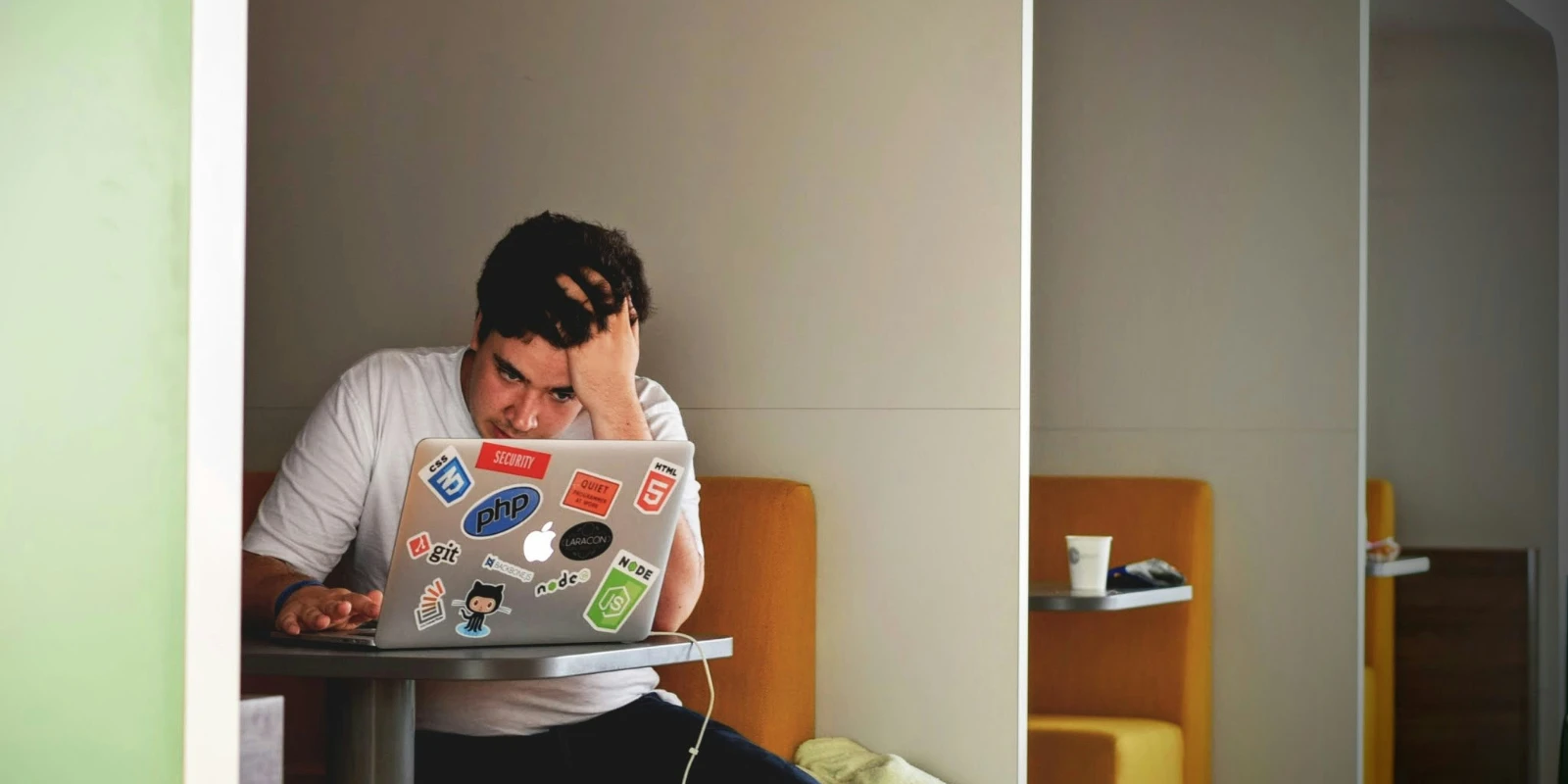
You start the morning with a clear plan. Write the report, reply to two emails, go to the gym, call your mum. By evening, half of it is still there, and you can't quite say where the day went.
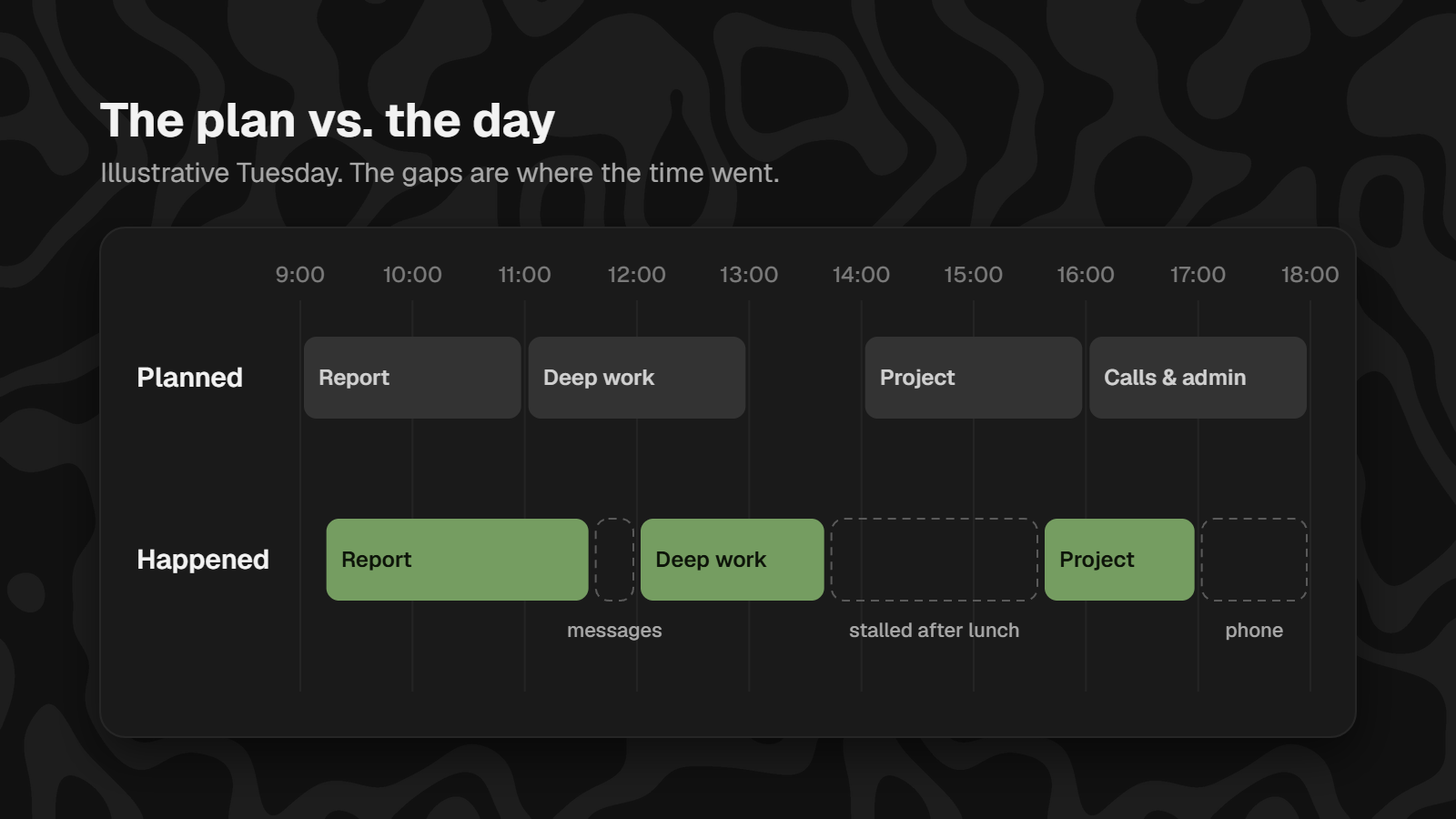
Most advice treats this as a discipline problem: try harder, wake earlier, download another planner. We think that's the wrong diagnosis. The plan usually isn't the problem. The problem is that the gap between what you planned and what happened is invisible, so you can't fix it.
This post is about making that gap visible, with or without PV0T.
The plan isn't the problem. The blind spot is.
Psychologists Daniel Kahneman and Amos Tversky gave this pattern a name in 1979: the planning fallacy. We predict how long things will take from the best-case version in our heads, and we underweight everything that went wrong the last time.
The interesting part is not that we underestimate. It's that we keep doing it, even when we know about it. The reason is simple: at the end of the day we remember the plan and the result, but not the path between them. Nobody keeps a record of the twenty minutes that disappeared after lunch.
So every new plan is built on the same wrong memory of how your days actually run. More willpower can't fix a measurement problem.
Three ways a day leaks
When we look at how planned days fall apart, the time almost always goes out through one of three holes.
- Estimates that were never true. The report you gave an hour takes two. Not once, but every time. If one kind of task always overruns, your plan was wrong before the day started.
- Interruptions you don't count. A message, a quick look at your phone, a colleague with "one question". Each one feels like a minute. Together they quietly eat whole blocks, and you rarely notice how many there were.
- Stalls at the same time of day. Many people have an hour where focus simply drops, often after lunch. Plan your hardest work there and it slides, day after day, and it feels like a personal failing instead of a pattern.
None of these show up on a to-do list. A to-do list only knows what was ticked off, not what happened in between.
A one-week experiment
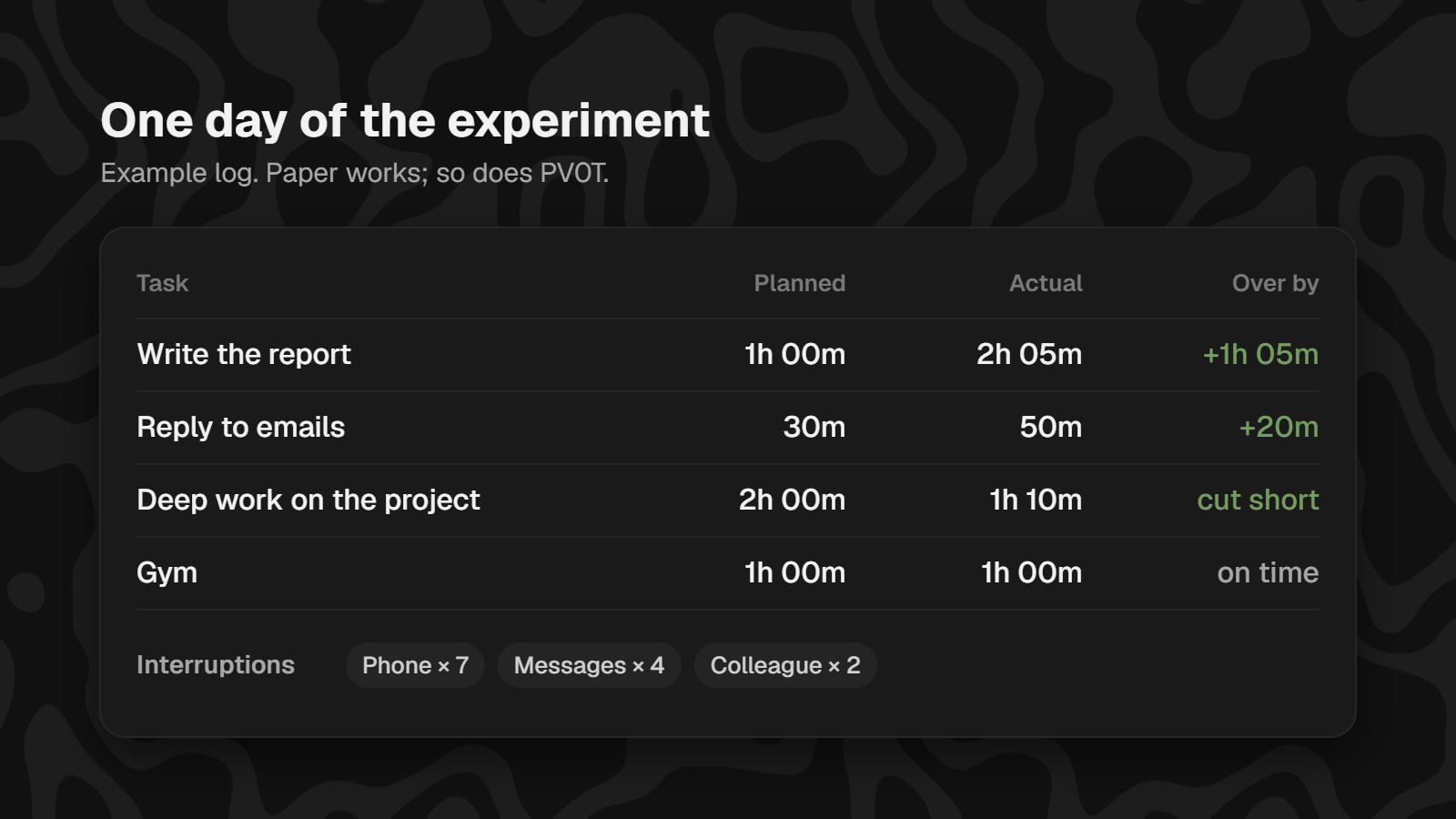
You don't need any app for this. A notes file or a sheet of paper works. The point is to record what happened while it happens, not to reconstruct it at night.
- Each morning, write the plan with times. Not just "write report", but "write report, 1 hour". The estimate is what you'll test.
- Note the real start and stop of each task. The moment you start, write the time. Same when you stop, finish or switch.
- Tally every interruption. One mark each time something pulls you away, with a word for what it was: phone, messages, someone at the door.
- Change nothing else. Don't try to be better this week. You are measuring a normal week, not a performance.
- On day seven, put the plan next to the record. That's where the patterns are.
It will feel slightly tedious for the first two days. That's normal, and it's also the most honest data about your days you've ever had.
What to look for on day seven
Read the week with three questions, one for each leak.
| Question | What you might see | What to change |
| Which tasks always overrun, and by how much? | Writing tasks take 1.5× your estimate, every time. | Plan them at 1.5×. Don't try to write faster. |
| What interrupts you most, and when? | Most marks say "phone", clustered in the afternoon. | Put the phone in another room for the afternoon block. |
| When do tasks stall? | The same hour goes quiet day after day, often after lunch. | Move routine work there and protect a better hour for the hard things. |
You'll probably find one leak that's bigger than the others. Fix that one. Then run the week again and see whether the gap got smaller. That's the whole loop: plan, record, compare, adjust.
And none of it is about blaming yourself. A plan that leaks is information, not a verdict.
Where PV0T comes in
The hard part of this experiment is the recording, so that's the part PV0T makes easy: one tap, and the comparison is ready when you want it.
- Plan your day with the tasks you mean to do, and a time if you like.
- Tap start when you begin a task. If your phone or a message pulls you away, tap that too.
- See where it leaked: planned against done, where your sessions stall, and what interrupts you most, built from your own sessions.
On Windows, the PV0T desktop app can also notice which app or site pulled you away, so you don't have to note it yourself.
You can start free at pv0t.com (no card needed) or run the paper version above first. Either way, give it one honest week. The patterns are usually there by day seven.
— The PV0T team